Buck Joins the Wolf Pack
The Call of the WildBuck Joins the Wolf Pack marks the final release of Buck from human claims and the completion of his return to the wild. The event is not a simple change of company: it follows the destruction of his deepest human attachment, confirms the strength he has acquired through violence and hunting, and establishes him as a leader whose life continues in both ecological reality and tribal legend.
Causes and Background
The immediate cause of Buck’s departure is the death of John Thornton. Buck understands death as the cessation of movement and recognizes that Thornton is gone, leaving a void comparable to hunger but impossible for food to fill. He broods beside the pool and roams through the camp, at times looking upon the bodies of the Yeehats who attacked it. His grief remains intense, but the world that held him among humans has been shattered. With Thornton dead, the last tie is broken: no human master, affection, or obligation remains to restrain Buck from answering the wild call.
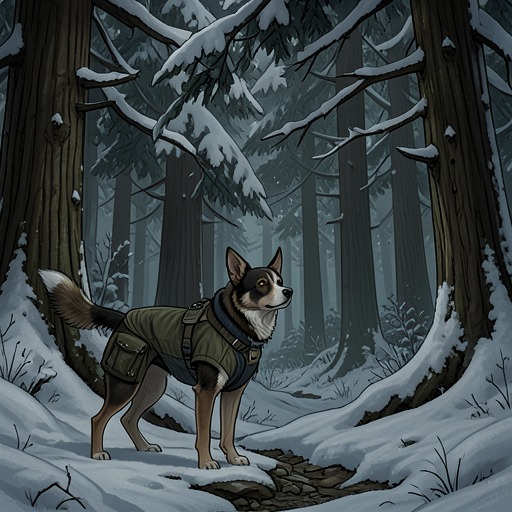
That call has been gathering force throughout Buck’s life in the North. He has learned the law of club and fang from the attack on Curly, the starving huskies, and the violent discipline of the sled-dog camp. He has discovered the exhilaration of pursuit when he led a pack after a snowshoe hare, experiencing the chase as an intimate bloodlust rather than as a merely practical search for food. He has also fought Spitz in a death struggle beneath the moonlit trees, recognizing the scene as something ancient and familiar, as though it belonged to a remembered world older than domestication. His meeting with the wild brother had already shown him that the call could be answered through companionship; Thornton’s death makes obedience to it possible without betrayal.
The Pack’s Arrival
As night falls after Thornton’s death, the forest becomes active around Buck. A faint, sharp yelp rises from the distance, followed by other yelps that grow steadily nearer. Buck recognizes the sound from an earlier, half-remembered world, but now it reaches him with greater force than ever. He stands in the open space and listens, prepared to obey. The wolf pack has crossed into his valley while following migrating moose toward lower winter ground, turning Buck’s private mourning into a public encounter with the wild community.
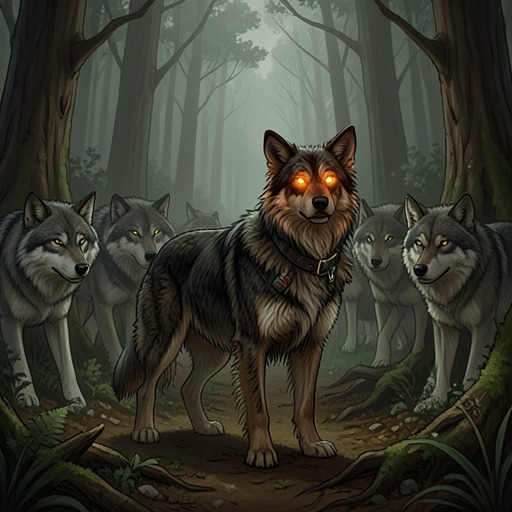
The wolves pour into the clearing in the moonlight, while Buck waits motionless at its center. His stillness and size initially awe them. When the boldest wolf leaps, Buck breaks its neck with a single strike. Three more attack in quick succession and retreat with blood running from slashed throats or shoulders. The entire pack then surges forward in a confused mass, trying to pull him down. Buck’s agility allows him to pivot, snap, and slash in every direction, but the numbers force him backward toward the pool and into the creek bed. He finally takes position against a high gravel bank, with three sides protected and only the open front exposed.
For half an hour Buck holds that position. The exhausted wolves eventually withdraw, some lying down with their heads raised, others watching him, and others drinking from the pool. The confrontation establishes that Buck is not merely another solitary predator seeking admission. He has the strength to resist the whole pack, the tactical awareness to use the bank as a defensive position, and the stamina to remain undefeated until the wolves abandon the attack.
Recognition and Joining
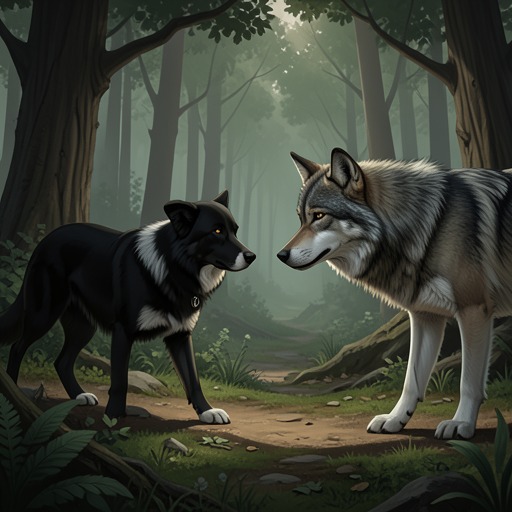
The first bridge between Buck and the pack is the gray wild brother he once followed across the watershed. The wolf approaches cautiously and whines softly. Buck answers, and the two touch noses. This recognition recalls their earlier meeting, when Buck pursued the frightened wolf without attacking until persistence convinced the animal that no harm was intended. They had then run side by side through forest, streams, and open country, with Buck feeling that he was answering the call beside a brother of the woods. Their reunion gives the final joining a personal continuity: Buck does not enter an entirely unknown society but returns to a relationship that had already opened the path toward freedom.
An old, battle-scarred wolf then advances. Buck begins the preliminary movement of a snarl, but he also accepts the older animal’s approach and sniffs noses with him. The old wolf sits, points his muzzle at the moon, and begins the long wolf howl. The others join him, and the call reaches Buck in unmistakable form. Buck sits and howls as well. Once the ritual of recognition is complete, he leaves the shelter of the gravel angle. The pack crowds around him in a manner that is half friendly and half savage, then its leaders raise the pack’s cry and spring into the woods. Buck follows, running beside the wild brother and yelping with the others.
This sequence changes Buck’s status. Earlier, he was a dog learning to survive among dogs that were described as ill-tamed wolves. Here, he is accepted by wolves after proving himself against them. His membership is achieved through endurance, combat, recognition, and shared vocal response rather than through human ownership or command. The pack does not tame him, and Buck does not surrender his independence; the encounter establishes a new belonging founded on wild competence.
The Ghost Dog Legend
The narrative extends beyond Buck’s literal disappearance into the forest and turns his joining into a legend among the Yeehats. In later years, the tribe notices changes in the timber-wolf breed: some wolves bear brown markings on the head and muzzle and a white rift down the chest. More remarkable is the report of a Ghost Dog running at the head of the pack. The creature is feared because it steals from Yeehat camps in harsh winters, robs traps, kills dogs, and defies the bravest hunters.
The legend grows through the unexplained deaths of hunters found with throats cruelly slashed and oversized wolf prints surrounding them in the snow. Each autumn, when the Yeehats follow the moose, they avoid a particular valley. The valley becomes associated with the Evil Spirit that has chosen it as an abiding place, showing how Buck’s presence alters the human map of the region: a place once used as camp becomes forbidden territory.
Yet the legend does not contain the whole of Buck’s life. In summer, when the Yeehats do not know of his visits, a great, richly coated wolf crosses alone from the smiling timberland into the valley. He comes to the open space where yellow liquid has flowed from rotted moose-hide sacks into the ground, where grass and vegetable mold have overgrown the remains. There he muses for a time and howls once, long and mournfully, before departing. The visit preserves a private memory beneath the public myth. Buck belongs to the pack, but he still returns alone to the physical traces of the camp and to the place associated with John Thornton.
In winter, however, the solitary visitor becomes the pack’s leader. Under pale moonlight or the glimmering borealis, he runs at its head, leaping above the other wolves and giving voice to the pack’s song. The contrast between his solitary summer mourning and his winter leadership makes his ending double rather than merely triumphant. Buck has found the life toward which his instincts drew him, but the memory of human love remains inscribed in the route he takes back to the valley and in the howl he gives before leaving it.
Narrative Significance
Buck Joins the Wolf Pack completes the book’s movement from civilization through coercion and labor toward a self-directed animal existence. Buck begins as a pampered dog from the Santa Clara Valley, is stolen for the Klondike Gold Rush, is beaten into submission by the man in the red sweater, and is educated by the sled-dog world in hunger, hierarchy, pursuit, and combat. His work in the harness becomes a source of pleasure, his rivalry with Spitz teaches him to contest leadership, and his hunting experiences awaken instincts deeper than his learned obedience. John Thornton then gives him a form of love that is not equivalent to ownership. Because Thornton’s bond matters so profoundly, Buck’s final departure only becomes possible after Thornton’s death.
The ending therefore joins grief to liberation. Buck does not leave humanity because his attachment to Thornton was meaningless; he leaves because that attachment was the last surviving human claim, and its destruction changes the conditions of his existence. His acceptance by the wolf pack converts accumulated experience into a new identity: hunter, fighter, companion, leader, and finally Ghost Dog. The pack’s howl is both a social welcome and the sound of an older world reclaiming him.
The event also gathers earlier scenes into a final pattern. Curly’s death taught Buck that the fallen receive no mercy; the starving huskies showed the danger of collective appetite; the pursuit of the snowshoe hare revealed the ecstasy of living prey; the wild brother demonstrated that fierce animals could form wary friendship; and the battle with Spitz prepared Buck to meet rivals without surrender. In the final encounter, these lessons operate together. Buck survives the pack, recognizes kinship within it, and enters the order of the wild not as a helpless victim but as its most formidable member. The story ends not with a return to an earlier home, but with Buck running forward into the world that has finally become his own.